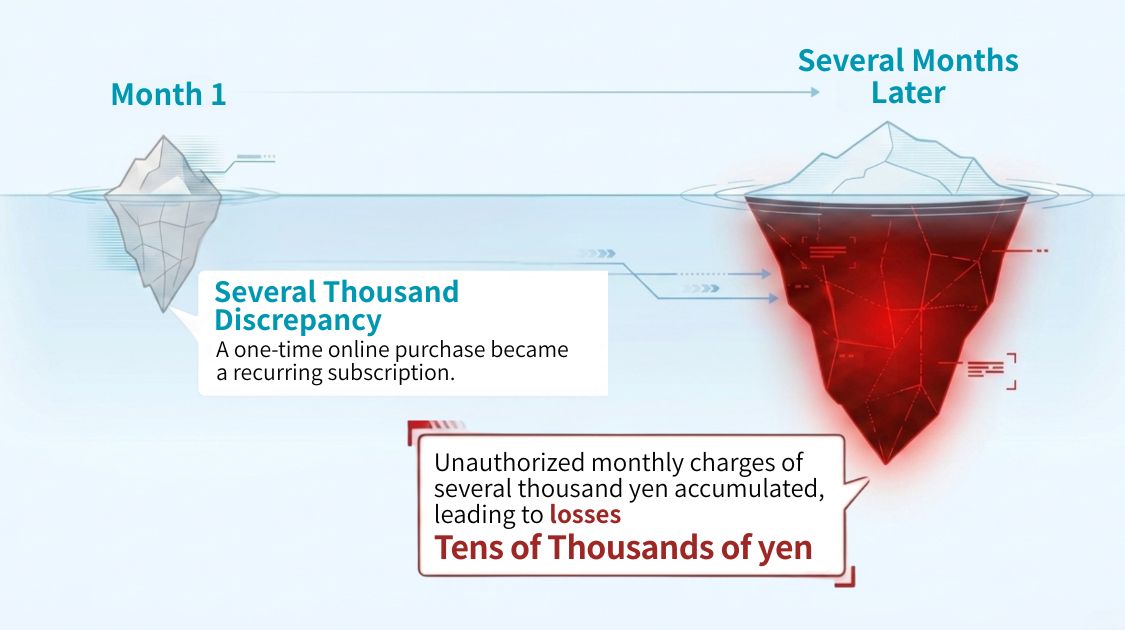



“Do you ever wonder why you can’t seem to save money even though you keep a household ledger every month?” “Do you feel like you’ve set a budget, but somehow always end up in the red by the end of the month?”
If you simply collect receipts and record your expenses in Excel or a notebook without further analysis, just tracking them won’t improve your household finances. The key to escaping inconsistent money management and reducing unnecessary spending lies in carefully comparing and analyzing your pre-set budget against your actual expenses.
In this article, I’ll explain in detail the benefits of comparing your budget and actual expenses. I’ll also introduce highly recommended household ledger tools that let you manage your finances intuitively—without tedious calculations.
Language: English Japanese
1. The Benefits of Comparing Your Budget and Actual Expenses

You may already be keeping a household ledger—but is it just a matter of recording? The most important aspect of effective financial management is comparing and analyzing the budget you set in advance with your actual expenses. By going beyond simply listing numbers and instead identifying the gaps between them, you can move away from rough estimates and gain clearer financial insight.
In this section, I’ll explain three key benefits of comparing your budget and actual expenses. Use this as a first step toward understanding your current financial situation and making more confident, sustainable improvements to your household finances.
1-1. Enables Objective Self-Evaluation

I thought I saved money this month by eating out less—so why don’t I have anything left over?
When it comes to managing your household finances, your intuition is often surprisingly unreliable. Only by placing your budget and actual expenses side by side—using tools like Excel—can you achieve truly objective self-evaluation.
For example, you might believe you kept your food expenses under $600. However, when you total your receipts and review your credit card statements, you may find that you actually spent $800. This kind of discrepancy clearly highlights the gap between perception and reality. On the other hand, you might discover that your spending on daily necessities—something you thought exceeded your budget—actually stayed within it.
Rather than relying on rough mental estimates, calculating the exact difference—whether a surplus or a deficit—allows you to reflect calmly and accurately on your spending habits. Objectively evaluating patterns that remain hidden when you only record expenses is the most reliable first step toward improving your financial situation.
1-2. Identifies the True Issues to Improve
I want to cut my monthly expenses, but I don’t know which categories to reduce.
By comparing your budget with your actual expenses, you can move beyond the vague anxiety of “not having enough money” and clearly identify the real issues that need attention. Instead of cutting back across all categories, you can focus only on the areas that truly matter.
Try calculating the difference—budget minus actual expenses—using a spreadsheet. This makes the causes of any shortfall immediately visible. For example, you might find that your utility and communication costs are right on budget, while your entertainment expenses exceed the limit by $150. In that case, reducing the number of nights out or reconsidering how much you spend on gifts will be far more effective than trying to save a few dollars on groceries.
By visualizing these numerical differences, you can move away from the stress of vague, across-the-board frugality and instead take focused, effective action on the spending habits that actually need adjustment.
1-3. Boosts Your Motivation
Even when I try to keep a household ledger, I can’t stick with it—I always give up after a few months…
Comparing and analyzing your budget and actual expenses can be a powerful way to boost your motivation to manage your finances. When you have a clear goal—your budget—monthly money management starts to feel more like a game, with clear targets to achieve.
At the end of the month, reviewing your actual expenses and staying within your budget brings a real sense of accomplishment. For example: “I set a $200 clothing budget, but only spent $180—saving $20” Accumulating these small wins builds positive momentum and encourages you to stay on track the following month.
Even if you exceed your budget, there’s no need to feel discouraged. Instead, you can adjust your plan in a way that fits your lifestyle: “Based on my spending, I’ll slightly increase my food budget next month and reduce my hobby budget.” This process of refining your budget makes it more realistic and sustainable.
2. Comparison Function in KAKEIBO PRO / LiGHT

When it comes to comparing and analyzing your budget and actual expenses, using a dedicated tool can make the process much smoother. That’s why I recommend KAKEIBO PRO and KAKEIBO LiGHT—tools I developed based on years of experience in household financial management and expertise in Excel.
These are specialized household ledger tools designed for those who want to manage their finances more effectively through detailed data analysis. In this section, I’ll introduce two powerful features that support budget vs. actual comparisons: the Dashboard and the Monthly Summary functions.
2-1. Dashboard Function

I’m not good at reading through lists of numbers. Is there a way to see at a glance how my spending compares to my budget?
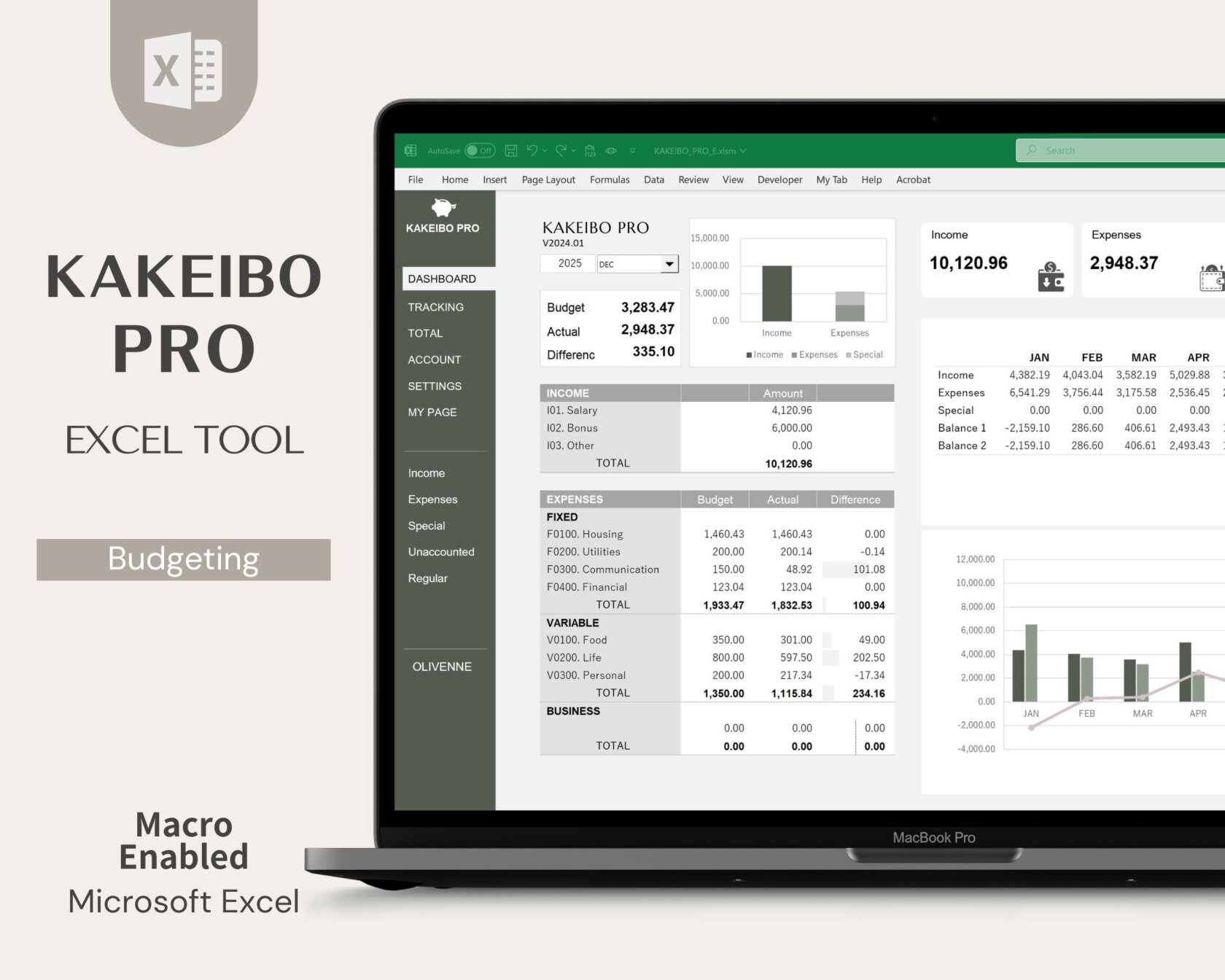
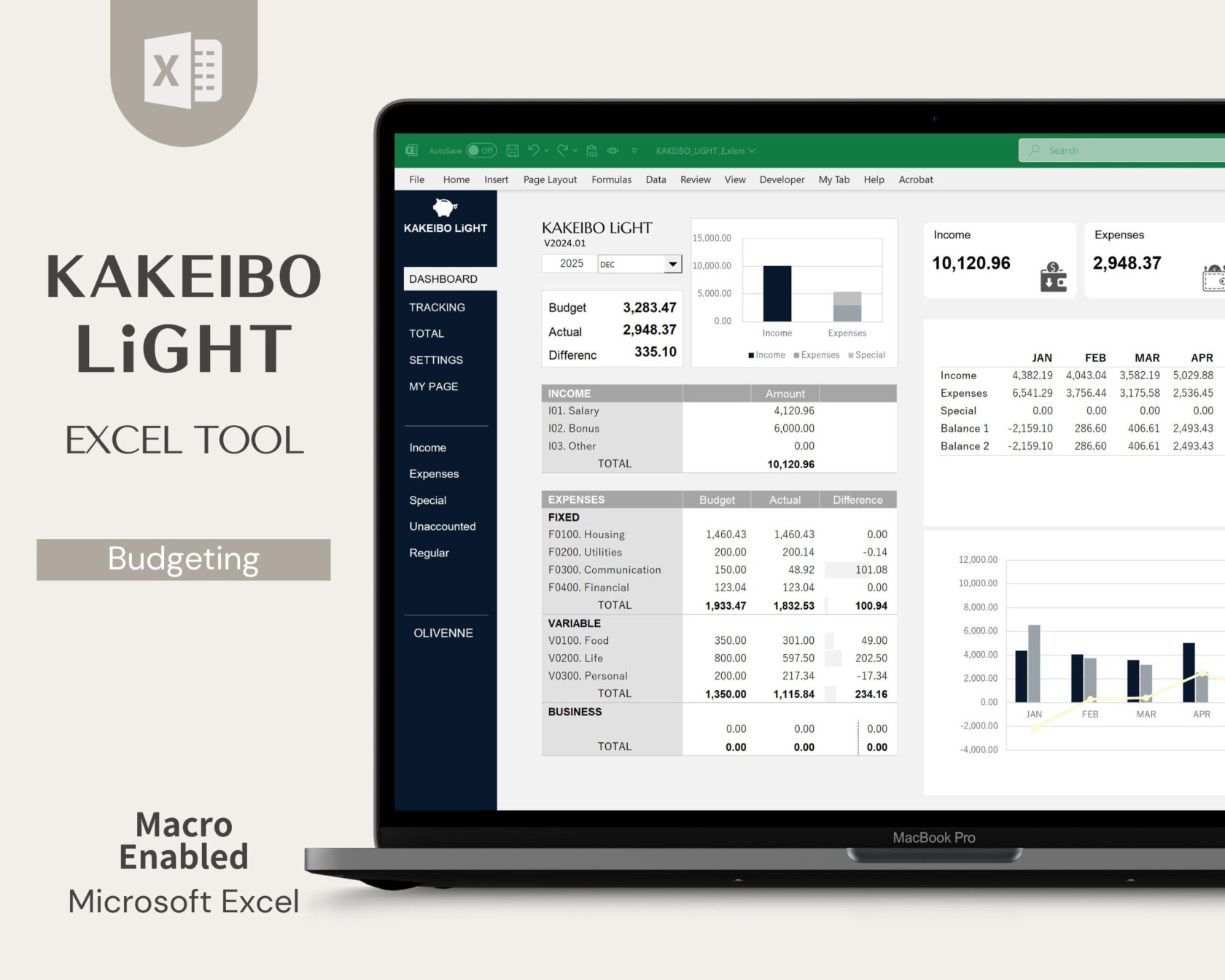
Setting up formulas and charts from scratch in Excel can be challenging. However, with the Dashboard function, you can skip all that hassle. You can simply enter your daily expenses, and the actual spending will be automatically calculated by category—such as Food and Daily Necessities —and reflected on the dashboard in real time.
The biggest advantage is that the difference between your budget and actual expenses is visualized using data bars. These colored bars expand and contract within each cell, allowing you to instantly grasp your financial situation based on their length. For example, if you’re only halfway through the month but your food category bar is already nearing its limit, you can quickly decide to cut back—such as cooking at home more often instead of eating out.
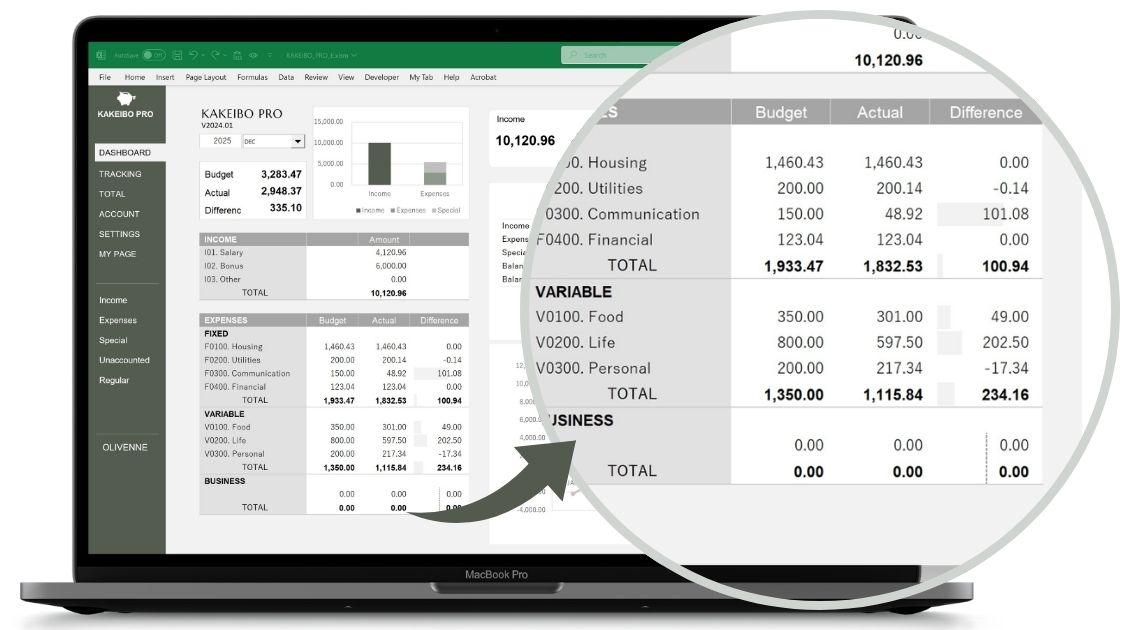
There’s no need to open multiple sheets or manually recalculate detailed figures. Because your financial status is presented visually, even busy individuals can easily adjust their spending habits and avoid exceeding their budget before it happens.
POINT
Its key feature is the automatic aggregation of expenses by category and the visual display of the difference between your budget and actual spending using colored data bars.
Because you can instantly and intuitively understand your financial situation without performing detailed calculations, you can easily adjust your spending habits and avoid going over budget before it happens.
2-2. Monthly Summary Function
When closing your household ledger at the end of the month, wouldn’t it be helpful to review your spending in detail and apply those insights to next month’s budget?
The Monthly Summary function in KAKEIBO PRO / LiGHT is designed to support exactly that kind of end-of-month review. Based on your daily entries, it automatically aggregates your expenses—not only by major categories but also by more detailed subcategories. Your budgeted amounts and actual spending are displayed side by side in a clear table, making it easy to spot any discrepancies.
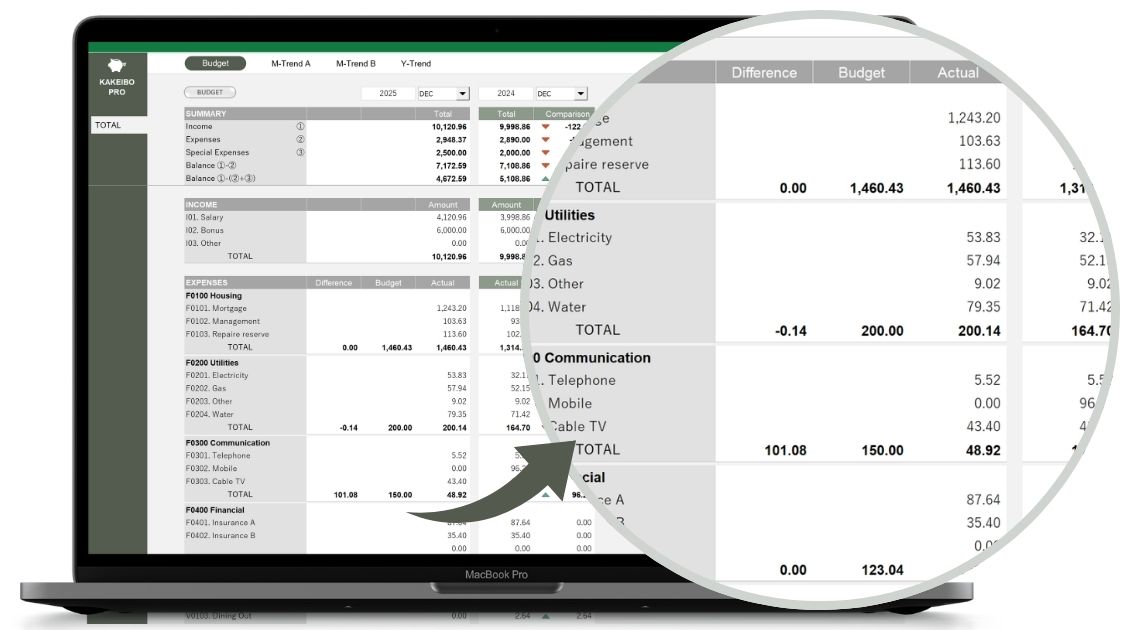
With this function, you can gain deeper insights into your spending patterns. For example, you might find that while your overall food budget stayed on track, the money you saved at the supermarket was offset by higher-than-expected spending at convenience stores.
It’s designed to function like a monthly report card for your finances, making reflection simple and effective. By clearly visualizing these numerical gaps, practical improvements naturally come to mind—for instance, “Next month, I’ll cut back on convenience store visits and reallocate that money to my daily necessities budget.”
Over time, this cycle of identifying inefficiencies and optimizing your budget becomes a natural and sustainable habit.
POINT
This feature automatically totals expenses by detailed item, allowing you to compare your budget and actual expenses side by side for each category in an easy-to-read list.
Since discrepancies become immediately visible, you can quickly identify unnecessary spending and apply those insights to concrete improvements and better budget planning for the following month.
3. Comparison Function in KAKEIBO SLiM

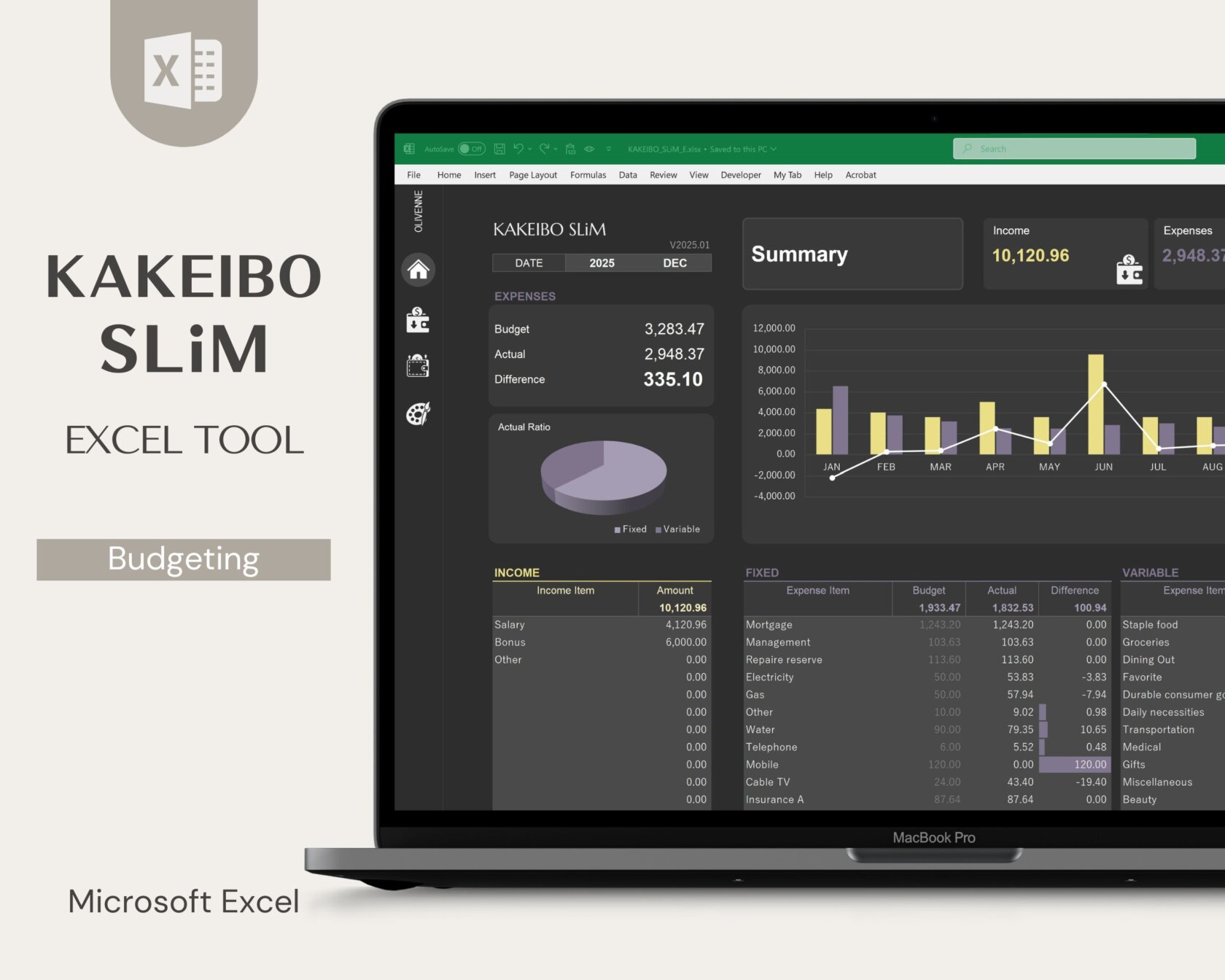
“I want to start keeping a household ledger, but I’m worried it might be too complicated to use…” For beginners who feel this way, I recommend KAKEIBO SLiM. This is a streamlined household ledger I developed based on my experience in financial management and expertise in Excel.
Unlike more advanced analytical tools, KAKEIBO SLiM simplifies both data entry and the interface while still covering the essential elements needed to improve your finances. It’s designed to be easy to use without sacrificing effectiveness.
In this section, I’ll introduce the key feature—the Dashboard function—which makes it simple to compare your budget and actual expenses at a glance.
3-1. Dashboard Function
I want to track my budget for each expense item, but is there an easy way to check it without complicated steps?
The Dashboard function in KAKEIBO SLiM is designed to provide exactly that—clear, at-a-glance insights with minimal effort. Simply enter your daily expenses, and they are automatically calculated by specific items such as Groceries, Eating Out, and Daily Necessities, then displayed in a concise list on the dashboard. One of its key strengths is that you can monitor your budget usage at a detailed item level, rather than only in broad categories.
In addition, the difference between your budgeted and actual amounts is visualized using colored data bars. As the bars expand within each cell, you can quickly and intuitively assess your situation. For example, if your dining-out bar is nearing its limit, you might decide to cook at home more often. On the other hand, if there’s still room in your daily necessities budget, you can shop with confidence.
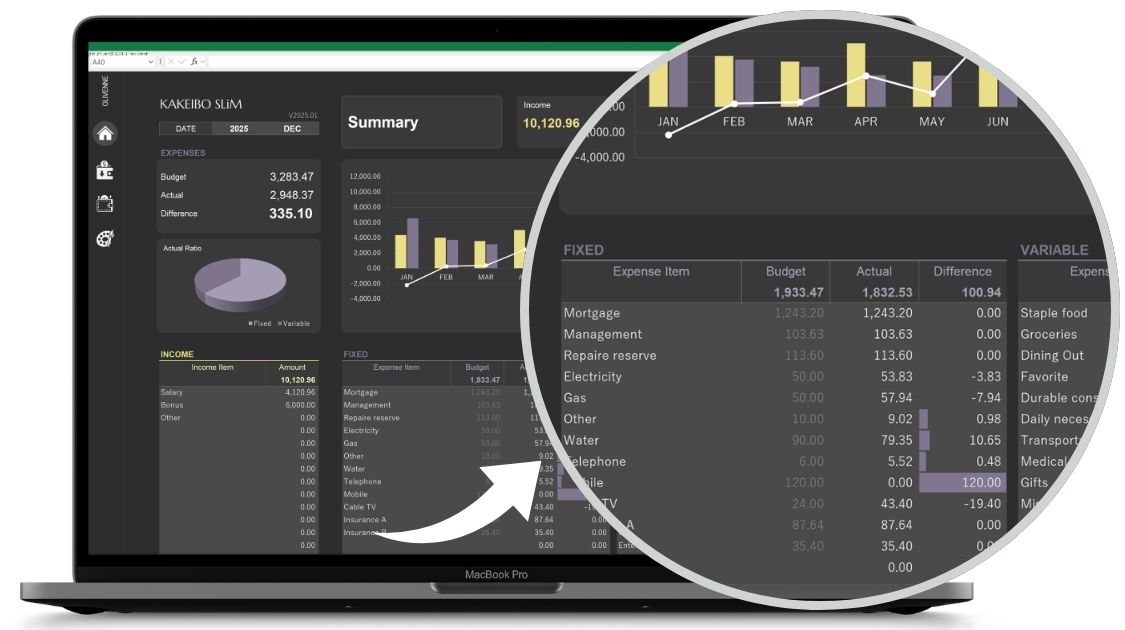
By eliminating the need for complex calculations or navigating multiple screens, this function focuses on what matters most: clear, item-level budget comparisons. Even if you’re not comfortable with detailed analysis, this feature makes it easy to identify unnecessary spending and take practical steps toward better financial management.
POINT
With simple and intuitive operation, this feature automatically tracks expenses by detailed item and visualizes the difference between your budget and actual spending using data bars.
Even beginners can easily see how much of their budget has been used, making it simple to spot unnecessary expenses and build sustainable household financial habits.
4. Conclusion
The key to successful household financial management is consistently comparing and analyzing your pre-set budget with your actual expenses. By relying on clear numbers—rather than intuition or assumptions—you can identify specific areas of waste, such as exceeding your entertainment budget by $150, and clearly understand what needs improvement. At the same time, the small achievement of “staying within budget this month” can significantly boost your motivation.
To make this process simple and effective, I highly recommend using tools like KAKEIBO PRO, LiGHT, SLiM introduced in this article. These tools eliminate the need for tedious calculations, allowing you to intuitively track your remaining budget with visual data bars and streamline your end-of-month reviews.
Choose the tool that best fits your lifestyle and preferences, and start by comparing your budget and actual expenses for just one month. With the right approach, improving your household finances can become a stress-free and even enjoyable habit.
Related Articles